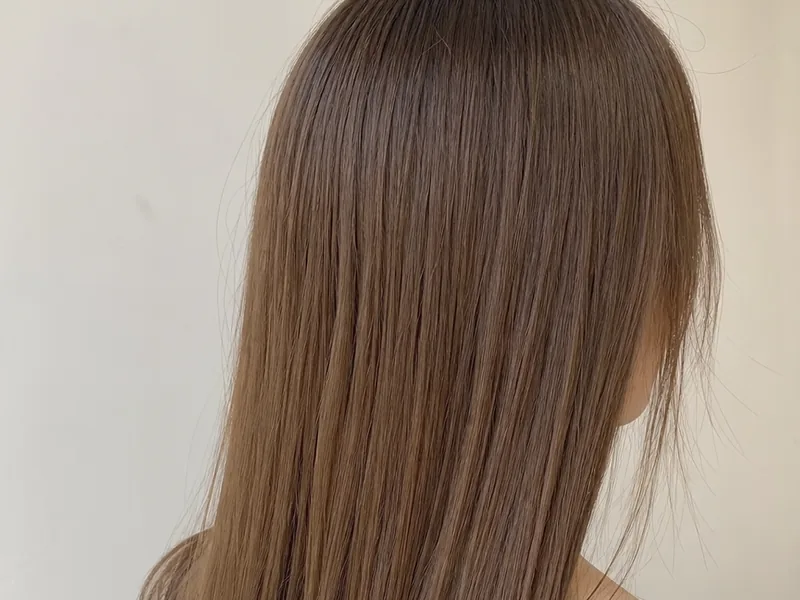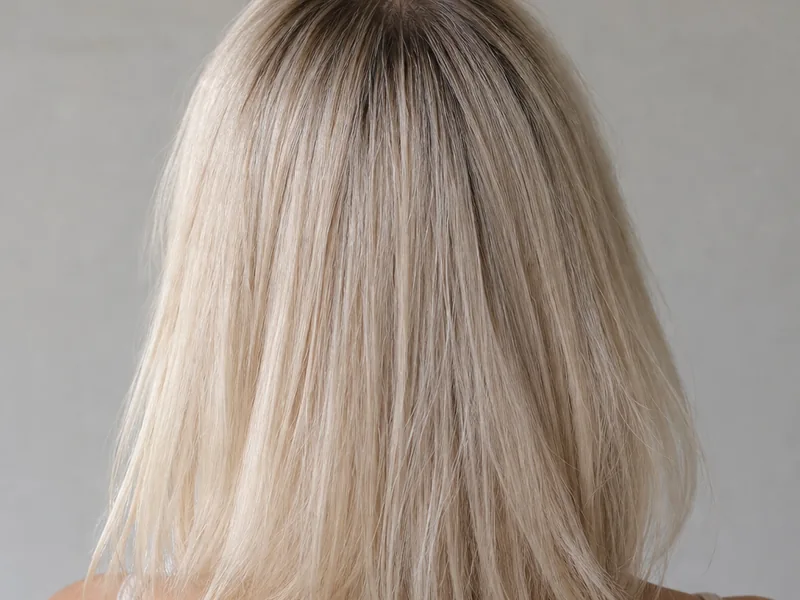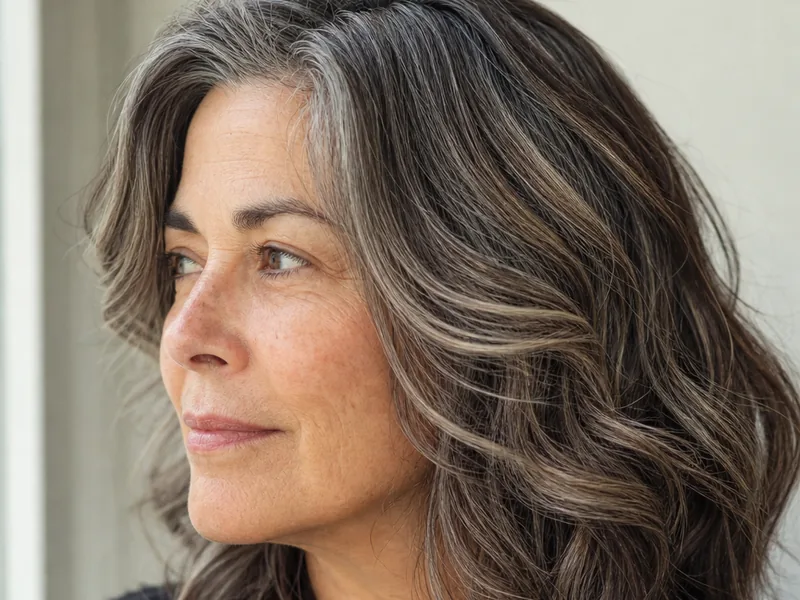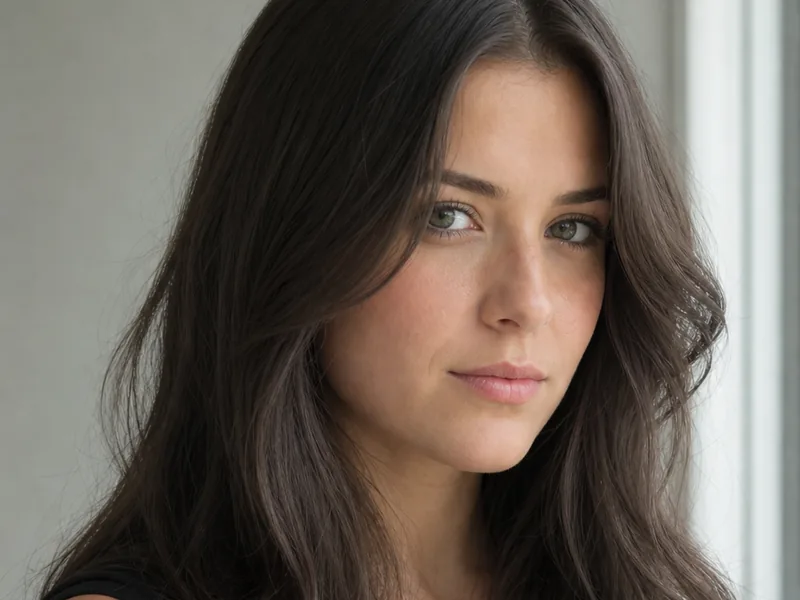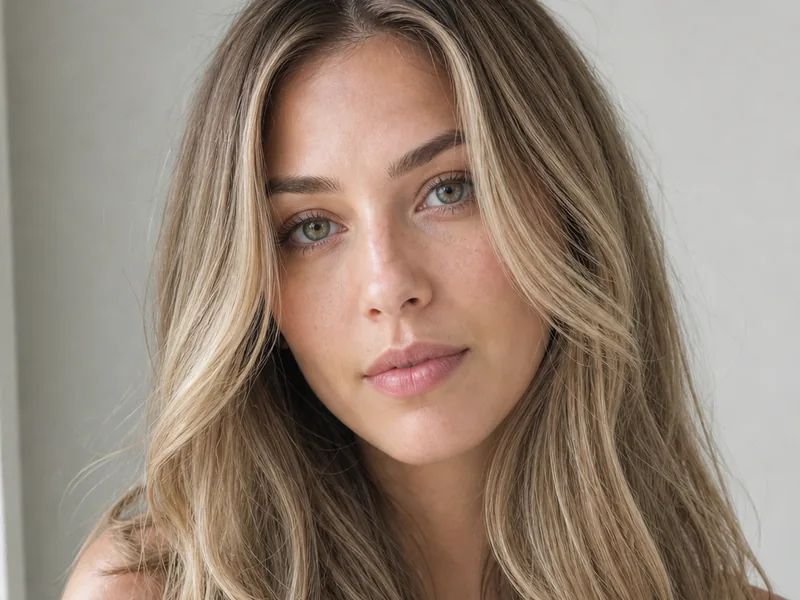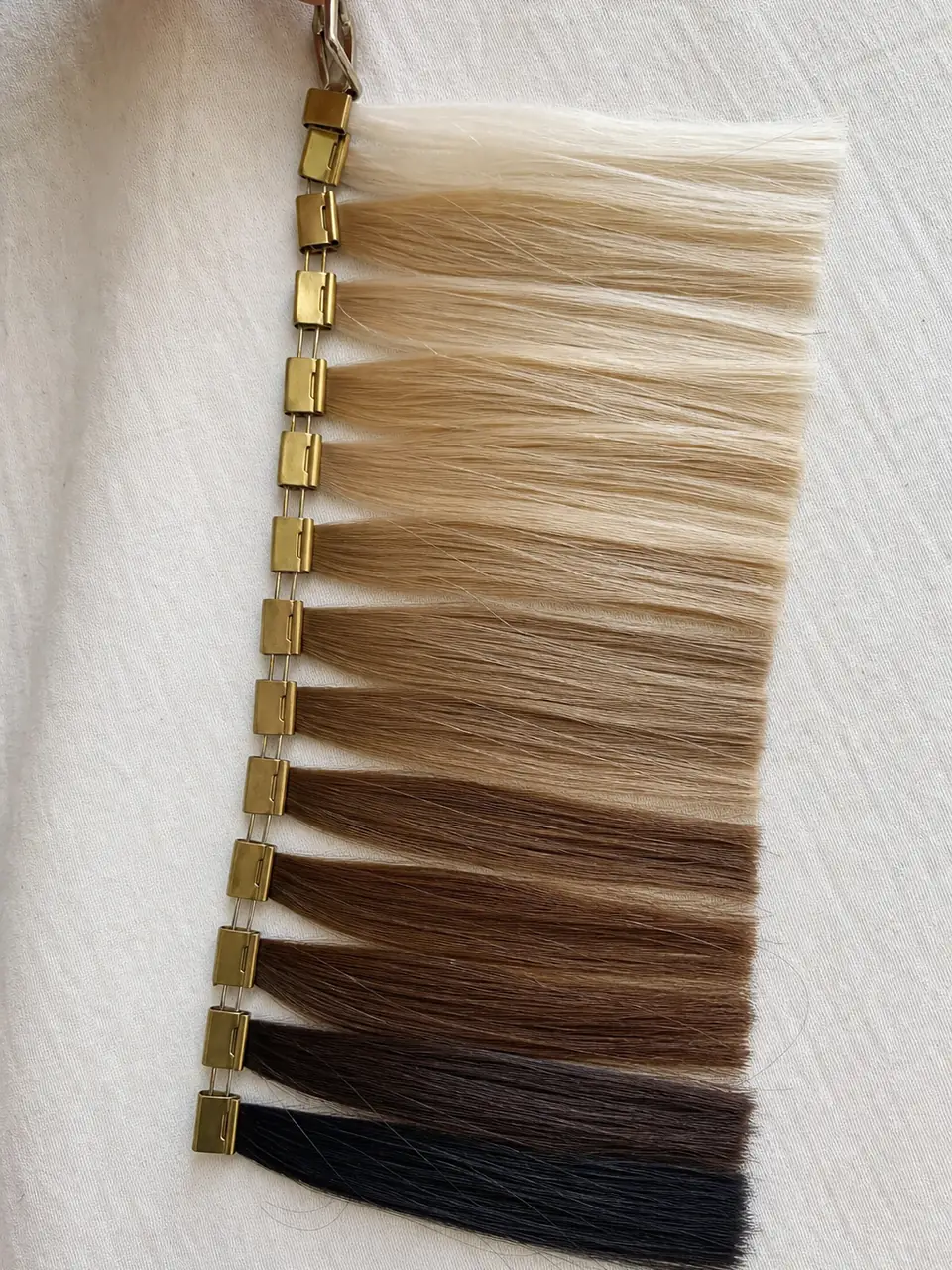
Short version: A hair color chart sorts hair by level, from 1 (black) to 10 (lightest blonde), and by tone, the warm, cool or neutral color you see within that depth. Each level hides an underlying pigment that shows when hair is lightened: red at the dark end, orange in the middle, yellow at the light end. Find your level at the roots in daylight, stay within 2-3 levels of it for a natural result, and use the color wheel to pick the tone that cancels the warmth you don't want.
The Hair Color Chart: Levels 1 to 10
A level measures depth only: how much light the hair reflects, not what color it is. Level 1 is the darkest, level 10 the lightest, and every shade name on a box or in a salon sits on one of these ten steps. The fourth column, which most charts leave out, decides how lightening will go.
| Level | Name | What it looks like in daylight | Underlying pigment exposed when lifted |
|---|---|---|---|
| 1 | Black | Solid black with a blue or ink sheen; no brown visible even in sun | Darkest red-brown |
| 2 | Darkest brown | Reads black indoors; shows brown only at the edges in strong light | Dark red-brown |
| 3 | Dark brown | Deep brown, a shade lighter than espresso; clearly brown outside, near black in dim rooms | Red |
| 4 | Medium brown | Chocolate brown, unmistakably brunette in any light | Red, edging toward red-orange |
| 5 | Light brown | Mid brown that throws warm glints in sun | Red-orange |
| 6 | Dark blonde | The shade most people call light brown or bronde | Orange |
| 7 | Medium blonde | Dark honey to "dishwater" blonde; looks brown-blonde indoors | Yellow-orange |
| 8 | Light blonde | Clearly blonde in any light, with some depth left | Yellow |
| 9 | Very light blonde | Pale blonde; scalp shows through at the part | Pale yellow |
| 10 | Lightest blonde | Near white, the base for platinum and silver once toned | Palest yellow |
Most hair people call black measures level 2 or 3 in daylight, not 1. And some professional lines add levels 11 and 12 for high-lift tints, extra-light permanent shades rather than separate hair colors.
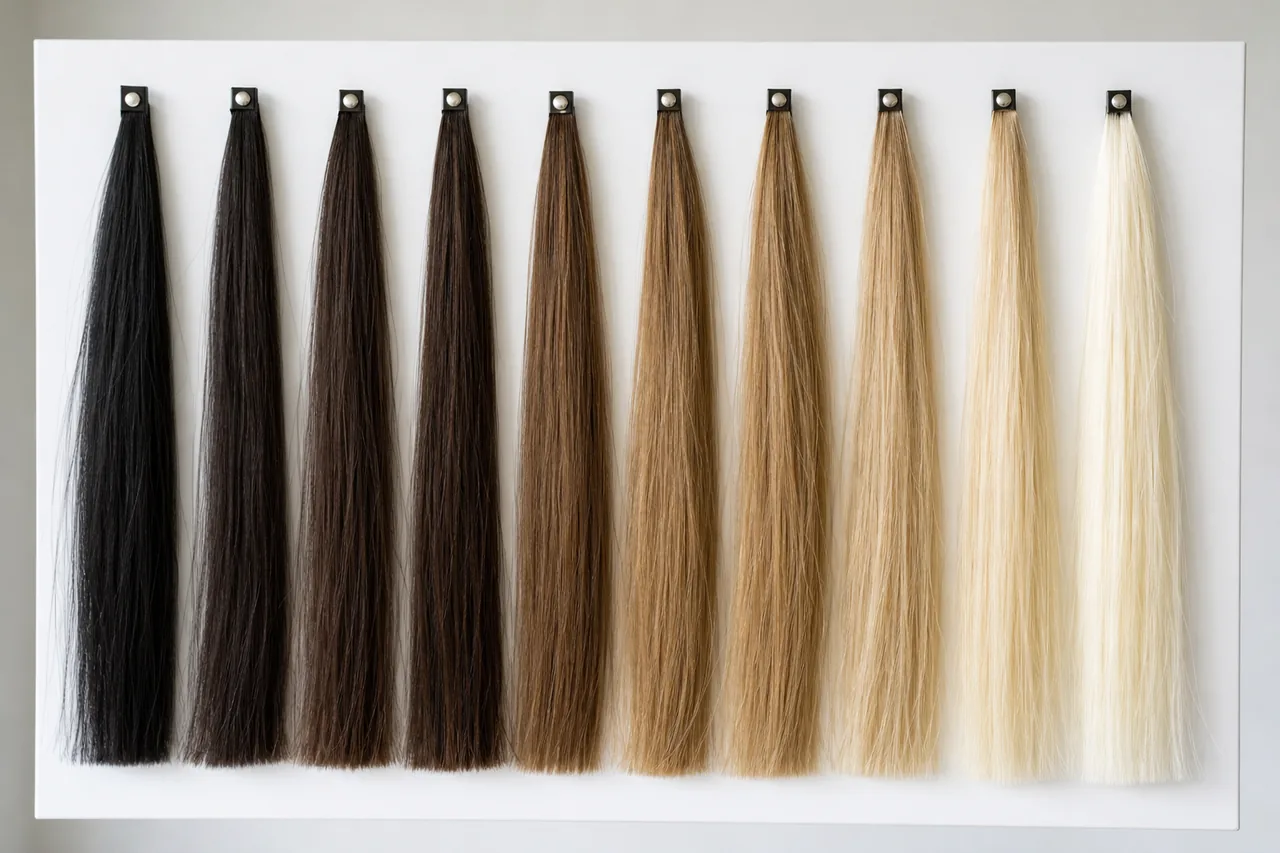
Salon note: Colorists judge level on dry hair, never wet. Wet hair reads noticeably darker, so a level guessed at the shampoo bowl tends to be too deep, and the formula built on it comes out lighter than expected.
Hair Color Tones and How Dye Numbers Work
Tone is the color reflect inside a level: ash, neutral, gold, copper, red, violet or a blend of them. Two level 6 shades can look unrelated when one leans ash and the other copper. Gold, copper and red are warm; ash and violet are cool; neutral balances the two.
| Tone | Built from | What it does | Typical use |
|---|---|---|---|
| Ash / cool | Blue, green or blue-violet | Cancels warmth; reads cooler and slightly deeper than its level | Ash brown at level 5, ash blonde at level 8, toning brass |
| Neutral (N) | A balance of warm and cool | Gives a natural, unshifted result | Gray coverage; the base mixed into most formulas |
| Gold | Yellow | Adds warmth and shine | Honey, golden brown, golden blonde |
| Copper | Orange | Adds a bright metallic warmth | Copper, ginger, copper brown |
| Red | Red | Adds saturated warmth | Auburn, cherry, red brown |
| Violet | Violet | Cancels yellow on blondes; adds a cool red-violet on brunettes | Icy blonde toners, burgundy, plum |
| Beige | Gold softened with ash or violet | A soft, sandy neutral that is neither brassy nor gray | Beige blonde at level 8-9, bronde at level 6-7 |
Level.Tone Numbering
Most professional and many box dyes use a level.tone code: the number before the dot or slash is the level, and the digits after it are the tones. The first tone digit is the main reflect; a second digit adds a smaller secondary reflect. So a shade written 7.1 means level 7 with one tone, and 7.13 means level 7 with a main tone plus a lighter touch of another. A repeated digit, such as 6.66, usually signals an intensified tone. Other systems use letters instead, such as 7A for ash or 5N for neutral, and a double letter like NN marks extra neutral base for resistant gray.
Watch out: Tone digits are not universal. The same digit can mean blue-ash in one line, green-ash in another and violet in a third, and some lines run half a level lighter than others. Read the tone legend printed with the specific product before choosing, and never mix shades from two different lines.
Underlying Pigment: What Lightening Reveals
Every natural level holds warm pigment underneath its visible color, and lightening exposes it in a fixed order: red, then orange, then yellow. That is why dark hair turns brassy halfway to blonde, and why no lightened hair is ever cool on its own; coolness has to be added back with toner.
The chemistry starts with melanin: natural hair color comes from the amount and ratio of black-brown eumelanin and reddish-brown pheomelanin. In a chemical analysis of black, brown, blond and red hair, eumelanin fell steadily from black to blond while pheomelanin stayed at a low, fairly constant level, except in red hair, which held roughly equal amounts of both.
Lightener works by breaking that pigment down. A study of progressively bleached hair found extensive melanin granule degradation even after the mildest bleach, along with oxidative damage to cuticle and cortex proteins that is not limited to the pigment. In the chair, the deep brown goes first and the warm stages follow, each one costing condition, which is why big lifts are split over sessions.
Permanent dye takes a different route. Oxidative dye combines an alkaline agent and peroxide to swell the cuticle; small colorless dye precursors diffuse into the cortex, lighten some natural melanin, then oxidize into large colored molecules that stay trapped inside. That is how one product can lift natural hair a level or two and deposit a new tone in the same step, and why it can't remove artificial color already in the hair.
Salon note: When a dark blonde asks for a cool level 8, the formula has to beat yellow-orange, not just yellow. Many colorists lift a little past the target so the toner only has pale yellow to correct, because asking a toner to cancel heavy orange tends to leave the result muddy.
The Hair Color Wheel and Which Tones Neutralize Which
On the hair color wheel, tones that sit opposite each other cancel to neutral: violet cancels yellow, blue cancels orange and green cancels red. The wheel is built from three primaries (red, yellow, blue) and the secondaries between them (orange, green, violet), and every toner, purple shampoo and color correction is an application of those pairs.
The wheel leaves out depth: each unwanted tone appears at a particular level, and the fix has to match both.
| Unwanted tone | Usually appears at | Opposite on the wheel | Typical fix |
|---|---|---|---|
| Pale yellow | Levels 9-10 | Violet | Violet toner; purple shampoo between toners |
| Yellow-orange (brass) | Levels 7-8 | Blue-violet | Blue-violet toner or an ash-beige gloss |
| Orange | Levels 5-7 | Blue | Blue or ash toner; blue shampoo to maintain |
| Red-orange | Levels 4-5 | Blue-green | Ash brown gloss |
| Red | Levels 3-4 | Green | Green-based (matte) brown gloss |
| Green cast | Lightened levels 8-10, often after over-ashing or pool water | Red | Gold or red-gold gloss |
| Flat, gray or too ash | Any level | Gold or copper | Warm gloss to put back some reflect |
Toner Refines the Tone After Lightening
Toner is usually a demi-permanent gloss mixed with a low-volume developer, chosen by reading the hair's current level and leftover warmth against the wheel. It deposits the opposite tone without lifting further, and it fades in about 4-8 weeks, so blondes and lightened brunettes refresh it on that cycle.
Purple and Blue Shampoo Maintain, They Don't Correct
Purple shampoo leaves a thin layer of violet pigment that dulls yellow at levels 9-10; blue shampoo does the same job on orange at levels 5-7. Used once or twice a week, not every wash, they hold a toner's result between appointments. Used daily, they leave pale blonde lilac or gray and make light hair look flat.
How to Find Your Natural Hair Color Level
Your level is read at the roots, on dry, clean hair, in daylight, by comparing depth only. Ends, sun-faded lengths and anything previously colored will mislead you. If your hair is dyed, you have two levels, the natural one at the root and the colored one through the lengths, and both matter for the next step.
- Find daylight. Stand next to a window in indirect daylight, out of direct sun. Warm indoor bulbs make hair read darker and redder than it is.
- Use the root. Part the hair at the crown and look at the first 1-2 cm of growth. That is your natural level, unaffected by dye or sun.
- Judge depth, not tone. Squint slightly, or picture the hair in black and white, so warmth doesn't trick you into calling it lighter.
- Compare against the chart. Hold a section flat next to the level descriptions above, or against real hair swatches if a salon has a swatch ring. If it sits between two levels, the darker one is usually closer.
- Note your gray separately. Estimate the percentage of gray (a quarter, half, most), then judge the level of the pigmented hair beside it. Gray reads lighter than it is and pulls the overall impression up.
Phone photos are the least reliable judge of level. Cameras adjust exposure and white balance automatically, so the same root can look level 4 in one shot and level 6 in the next. For photos you send a colorist, use daylight, no filter, and a sheet of white paper beside the hair as a reference.
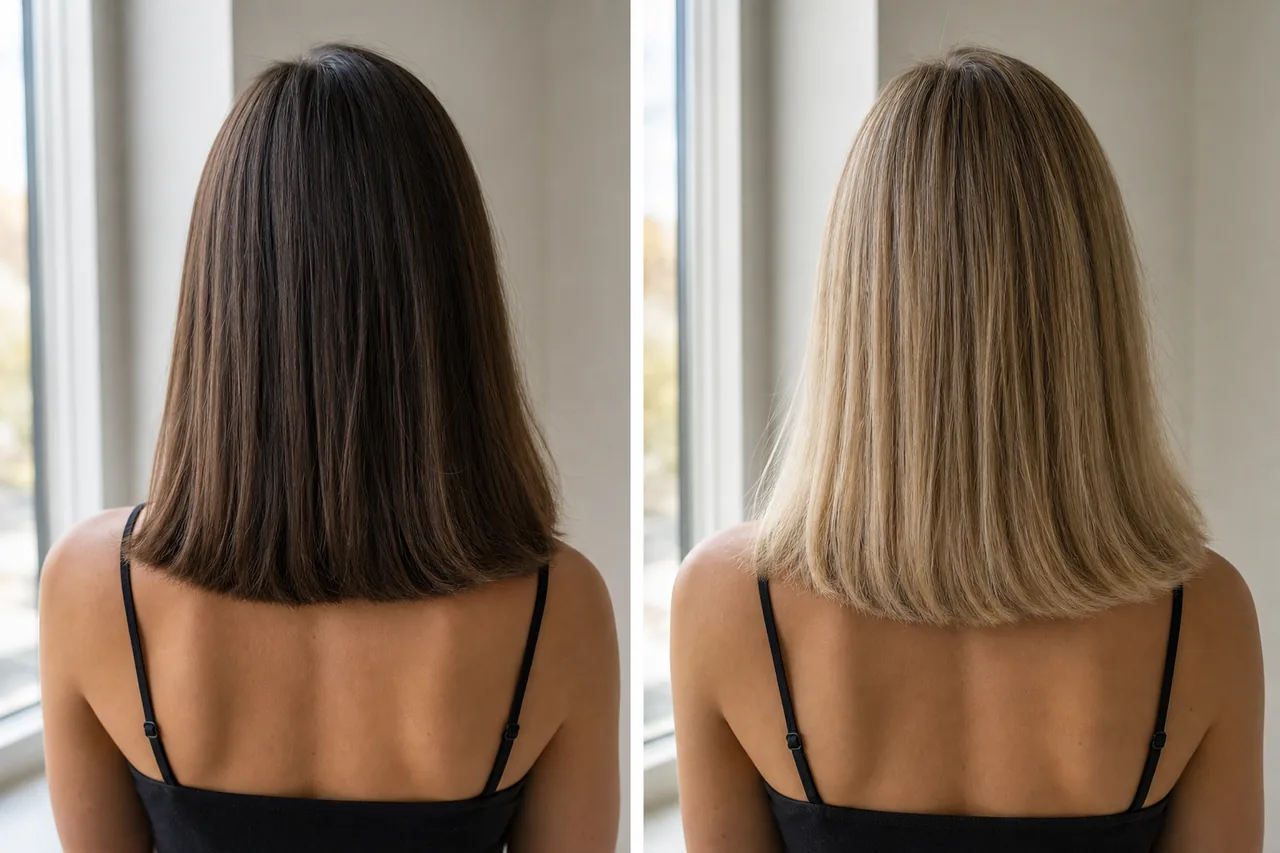
Shades of Brown Hair, Translated Into Levels and Tones
Most shades of brown hair are a level from 2 to 6 plus one tone, so the menu names on a box or in a salon can be decoded with the chart. The table gives the usual home of each name; individual lines may sit half a level either side.
| Shade name | Usual level | Tone | Reads as |
|---|---|---|---|
| Espresso | 2 | Neutral to cool | Near black with a brown edge |
| Dark chocolate | 3 | Neutral to slightly warm | Deep, glossy brown |
| Mocha | 4 | Neutral with a violet touch | Soft, cool-leaning medium brown |
| Chestnut | 4-5 | Red-gold | Warm brown with red in sunlight |
| Ash brown | 5 | Ash | Cool, smoky light brown with no red |
| Mushroom brown | 5-6 | Ash with beige | Gray-leaning taupe brown |
| Honey brown | 5-6 | Gold | Light brown with a golden glow |
| Caramel | 6-7 | Gold-copper | Warm light brown to dark blonde, often painted over a darker base |
| Auburn | 4-6 | Red, sometimes red-violet | Red-brown rather than orange |
Blonde names decode the same way: golden blonde is usually a level 8 with gold, platinum a level 10 toned with violet. Mahogany, a red-violet brown, blends two tone rows rather than being a tone of its own.
How to Use Levels and Tones to Pick Your Target Shade
Pick a target within 2-3 levels of your natural color, then choose the tone that works with, or against, the underlying pigment at that level. That range looks natural, grows out softly and usually fits one appointment; bigger jumps cost sessions, condition and upkeep.
- Start from both levels. Write down your natural root level and, if you color, the level of your lengths.
- Choose a direction. Lighter means lift; darker or the same level means deposit only. The table below shows what each move takes.
- Check your history. Color doesn't lift color: permanent dye can lighten natural pigment but not old dye, so dyed lengths need a color remover or lightener to go lighter. Henna and some plant dyes can react unpredictably with lightener; tell the colorist and expect a strand test.
- Pick the tone against the underlying pigment. Lifting to level 7 reveals yellow-orange. A gold or copper target works with it; an ash target has to cancel it, which takes a stronger toner and more frequent refreshes.
- Patch test. Do a patch test 48 hours before every permanent or demi service, even with a shade you've used before.
| Move on the chart | What does it | Sessions | At home or salon |
|---|---|---|---|
| Same level, new tone | Demi-permanent or semi-permanent gloss | 1 | Either |
| 1-2 levels darker | Demi or permanent dye | 1 | Either |
| 3+ levels darker on lightened hair | Warm filler first, then the target shade | 1 | Salon |
| 1-2 levels lighter, natural hair | Permanent dye with 20 volume developer (about 2 levels of lift) | 1 | Either; salon for an even result |
| 3-4 levels lighter, natural hair | Lightener plus toner, or high-lift tint from level 6 or lighter | 1-2 | Salon |
| 5+ levels lighter (level 2-3 to blonde) | Lightener over several sessions, plus toner | 2-3 or more | Salon |
| Any lift over dyed hair | Color remover or lightener; strand test first | 1-3 | Salon |
Salon note: A useful phrase at a consultation is the target written as level and tone, such as "a level 7 with a gold-beige reflect, no copper." It gives the colorist a number to formulate from, and it exposes any mismatch with your starting level before the color is mixed.
Common Mistakes When Reading Levels and Tones
Most color surprises come from reading a chart as if it showed results, when it only shows the dye. The result is always the dye plus what is already in your hair: its level, its leftover warmth and its history.
Dye Over Dye Only Goes Darker or Shifts Tone
A lighter box shade applied over previously dyed lengths can't lift the old pigment. The lengths stay at their current depth with a new reflect, while the virgin roots lift to the shade on the box. The mismatch is the familiar "hot roots": bright warm roots above darker, duller ends.
A Swatch Shows the Dye on White Hair, Not on Yours
Chart swatches are usually colored on white or very light hair. On a level 4 base, a level 7 copper swatch comes out darker and redder, because the dye sits on top of red-orange underlying pigment instead of a blank base.
Ash Shades Look Darker Than Their Level
Cool tones absorb more light, so an ash shade often reads about half a level deeper than a gold one of the same number. On porous or very light hair, ash can also turn gray or greenish. Pick ash a level lighter than your target if depth matters.
Violet Toner Cannot Cancel Orange
Violet is yellow's opposite, not orange's. On level 6-7 hair that lifted orange, a purple shampoo or violet toner barely moves the color; blue or blue-violet is needed, matched to the level.
Porous Ends Grab Color Darker
Lightened or sun-worn ends absorb dye faster than new growth, so one formula applied root to end can leave them a level darker. Colorists apply roots first and pull color through the ends only for the last minutes.
Myths About Levels, Tones and Toning
A few beliefs about levels and tones cause most at-home mistakes. Each sounds reasonable and fails predictably.
Myth: A Level 6 Is the Same in Every Brand
Reality: The 1-10 scale is a shared convention, not a standard. Lines can sit half a level apart and use different tone digits, which is why a familiar number from a new line can still surprise you.
Myth: Purple Shampoo Lightens Hair
Reality: It deposits a trace of violet and lifts nothing. It makes yellow look less yellow, but a level 7 stays a level 7.
Myth: Natural Black Hair Is Level 1
Reality: Most naturally black hair measures level 2 or 3 in daylight. Level 1 is mostly reached with dye, which matters because dyed level 1 is far harder to lift than natural level 2.
Myth: Going Darker Is the Safe Choice
Reality: It is gentle on the hair but hard to reverse. Lifting dark dye back out takes a remover or lightener, often over several sessions, and the hair turns warmer on the way up. A demi-permanent shade that fades is the safer trial.
Myth: Higher Developer Gives Better Color
Reality: Developer volume controls lift, roughly 1 level at 10 volume, 2 at 20, 3 at 30 and 4 at 40, and higher volumes mean more damage and more scalp irritation. Deposit-only work and gray coverage don't need extra lift.
A hair color chart is only as useful as the level you start from, so read your roots in daylight before choosing anything. Then pick a target within 2-3 levels, choose its tone with the underlying pigment in mind, and if the move involves lift or old dye, book a consultation and a strand test first.
Frequently Asked Questions
What do the numbers on hair dye mean?
The first number is the level, from 1 for black to 10 for the lightest blonde. Anything after the dot, slash or letter describes the tone, such as ash, gold or copper. A second tone digit adds a weaker secondary reflect. Tone digits are not standardized, so the same number can mean a different tone in another line; always check the legend for that specific product.
What level is dark brown hair?
Dark brown is level 3 on the standard chart, with darkest brown at level 2 and medium brown at level 4. Many people who describe their hair as black are actually level 2 or 3 when checked at the roots in daylight. If your hair looks black indoors but shows brown at the edges outside, you are probably a level 2.
How many levels can hair dye lift?
Standard permanent dye lifts natural hair about one to two levels, and high-lift tints can reach roughly four on hair that starts at level 6 or lighter. Neither can lighten hair that has been dyed before. Anything beyond that, or any lightening over old color, needs lightener, which works faster but costs more condition and usually ends in a toner.
What color cancels out orange in hair?
Blue cancels orange because the two sit opposite each other on the color wheel. A blue or ash-based toner, or a blue shampoo used once or twice a week, neutralizes orange on hair around level 5-7. If the warmth is closer to yellow-orange at level 7-8, a blue-violet toner works better than pure blue.
Is level 1 the darkest hair color?
Yes. Level 1 is black, the darkest step on the chart, and level 10 is the lightest blonde. Some professional lines add levels 11 and 12 for high-lift blondes. If you are choosing a dye, a level 1 is a blue-black or jet black shade and the hardest level to lighten out later, so a level 2 often gives a softer black.
What does N mean on hair dye?
N stands for neutral, a balanced tone that is neither warm nor cool. Neutral shades give the most natural-looking result and are the usual base for covering gray, since gray strands have no pigment of their own to support the color. A double N signals extra neutral base for coarse or resistant gray.
Can you go from dark brown to blonde in one day?
Sometimes, but it is rarely the kindest route. Taking level 3 dark brown to level 8 blonde means passing through red and orange stages, and doing it in one session costs more condition than spreading it over two or three. Previously dyed or henna-treated hair is even less predictable, so expect a strand test and a staged plan.
General information, not medical advice. Patch test 48 hours before any permanent or demi-permanent color. Brand-neutral: we name no products and take no payment for mentions. Disclaimer · How we write our guides